Kotick and the seal people
The Jungle BookKotick and the seal people are joined by a migration relationship shaped by danger, disbelief, and eventual collective transformation. The white seal first stands apart because he has witnessed what the other seals have not: the organized human slaughter of the holluschickie. His search for a secure rookery therefore becomes a struggle not merely for his own survival but for the future habitat of the entire seal community. When persuasion fails, he forces the issue through combat, wins the community's recognition, and leads thousands of seals toward a place where no man comes.
A Community Exposed to Human Violence
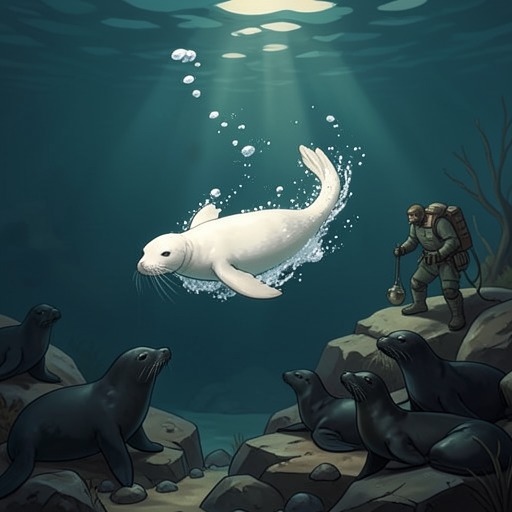
The seal people gather seasonally at Novastoshnah, a beach described as offering the finest accommodation for seals anywhere in the world. In summer, hundreds of thousands arrive from the cold gray sea, making the rookery both a place of abundance and an obvious target. Human organization turns that seasonal congregation into a killing system: Kerick Booterin and Patalamon select seals, drive them like sheep toward the killing grounds, allow them to cool so their fur will not come off in patches, and then send men armed with iron-bound clubs to strike them down.
Kotick's relation to the community changes when he becomes an eyewitness to this process. He has never seen a man before, and the other young seals merely stare as the hunters approach. The white coat that makes Kotick remarkable also makes him a figure of superstition to Kerick, who mistakes him for the ghost of the dead Zaharrof. Yet Kotick's importance is not mystical. He follows the drove to the killing grounds, sees the clubs fall, and returns to the sea horrified; ten minutes later, he can no longer recognize his friends because their skins have been ripped away and piled on the ground.
The other seals refuse to share the knowledge that now separates Kotick from them. They tell him that men have always driven the holluschickie and that witnessing unpleasant things is his own fault. Sea Catch advises him to grow large, establish a nursery, and wait until he is strong enough to fight for himself; Matkah likewise tells him that he will never stop the killing and should return to play in the sea. The community treats the slaughter as an unalterable part of ordinary life, while Kotick understands it as a condition that demands escape.
Kotick's Search for a New Rookery
That autumn Kotick leaves Novastoshnah alone, driven by the idea of finding Sea Cow and a quiet island with firm beaches where men cannot reach the seals. His search extends across the Pacific and continues for five seasons, with swimming journeys that can cover as much as three hundred miles in a day and a night. He nearly falls prey to several sharks, survives storms and hostile coasts, and repeatedly discovers that apparently suitable islands have already been damaged by human exploitation.
The pattern is consistent. A beach may be hard, sloping, and ideal for a nursery, but smoke from a whaler on the horizon reveals the danger of human presence. Elsewhere, Kotick finds the remains of seal colonies that men have killed off, learning that a place visited by men once may be visited by them again. At Kerguelen Island he is nearly smashed against black cliffs during a sleet storm with lightning and thunder, only to discover that seals had formerly occupied that coast as well. His route includes the Gallapagos, the Georgia Islands, the Orkneys, Emerald Island, Little Nightingale Island, Gough's Island, Bouvet's Island, the Crossets, and a small island south of the Cape of Good Hope; everywhere, the People of the Sea give him the same warning that men have destroyed the earlier rookeries.
Near the end of this search, Kotick finds an old dying seal who identifies himself as the last survivor of the Lost Rookery of Masafuera. After Kotick catches fish for him and tells him of his failures, the old seal recalls a beach tradition: one day a white seal from the North would lead the seal people to a quiet place. The prophecy gives shape to Kotick's isolation. He is not simply an unusual seal seeking personal comfort; his singular body and singular purpose make him the possible guide of a displaced population.
The Sea Cow's Tunnel and the Question of Belief
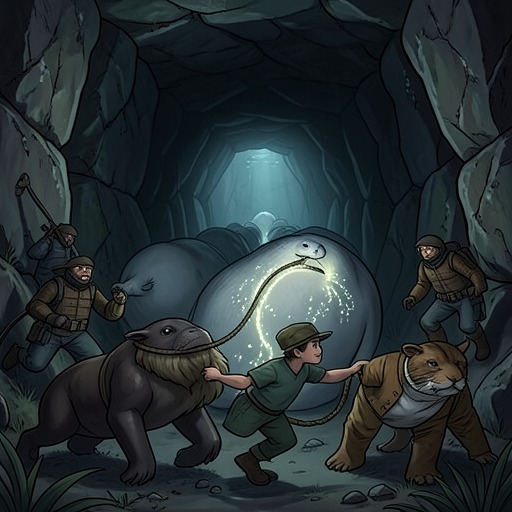
Kotick eventually follows sea cows through a deep underwater passage. The creatures descend through clear water, enter a dark opening twenty fathoms beneath a cliff, and lead him through a tunnel to another coast. There he finds smooth rock extending for miles, hard-sand playgrounds sloping inland, rollers, grass, dunes, and low sandy islands partly hidden by fog. The water tells him that no men have ever reached the place. Offshore bars, shoals, and rocks would prevent ships from approaching within six miles, while perpendicular cliffs protect the landward side; the tunnel provides the only secret entrance.
The new rookery answers every problem Kotick has encountered. Its fishing is good, its beaches are suited to seal nurseries, and its geography offers protection rather than merely temporary concealment. Kotick explores it carefully before returning, diving through the tunnel again so that he can answer the objections of the seals he has left behind. His journey home takes six days, and the seal waiting for him immediately recognizes from his eyes that he has found the island at last.
The community nevertheless laughs at him. A young seal argues that Kotick cannot come from an unknown place and order the others away when he has never fought for a nursery. The objection reveals the community's values: authority belongs to those who defend an existing territory, while exploration is dismissed as aimless prowling. Kotick answers that he has no nursery to fight for and wants only to show them a place where they will be safe. His practical solution cannot yet compete with the prestige of customary combat.
From Rejection to Collective Migration
When the young seal agrees to follow Kotick only if Kotick wins a fight, Kotick attacks before the challenge can be withdrawn. He bites the young seal's neck, drags him down the beach, shakes him, and knocks him over. Then he declares that he has spent five seasons seeking safety for the community and that the seals will not believe him unless their stubbornness is physically overcome.
The fight becomes a public test of Kotick's claim to leadership. He attacks the largest sea catch he can find, choking, striking, and throwing aside one opponent after another before moving to the next. His body gives him an advantage the older seals do not expect: he has not endured their annual four-month fast, and his deep-sea journeys have kept him in perfect condition. Although he has never fought before, his unspent strength and accumulated purpose make him formidable. Sea Catch watches his son overturn old seals and young bachelors alike, then acknowledges that Kotick is the best fighter on the beaches and refuses to oppose him.
At night Kotick stands above the torn and bleeding nurseries and demands an answer from the seals. He asks who will come with him to the Sea Cow's tunnel, threatening to teach the lesson again if they remain silent. The response is no longer laughter but a collective murmur: thousands of tired voices agree to follow Kotick, the White Seal. His victory changes the community's value system. Violence, which had formerly defended the exposed rookeries and preserved their old way of life, is now used to force recognition of a nonviolent objective: escape from the killing grounds.
Migration and Lasting Change
A week later Kotick leads nearly ten thousand holluschickie and old seals northward to the Sea Cow's tunnel. The seals who remain at Novastoshnah call the migrants idiots, showing that agreement is gradual rather than universal. Yet the migration has begun, and the new rookery proves its value through experience rather than argument. The migrants report on the beaches beyond the tunnel, and more seals leave Novastoshnah, Lukannon, and the other nurseries in successive years.
The movement therefore becomes larger than Kotick's original expedition. It is not completed at once because the seals need time to reconsider inherited habits, but year after year the population shifts toward the quiet, sheltered beaches. Kotick remains there throughout the summer, growing larger, fatter, and stronger while the holluschickie play around him in water untouched by men. His relationship with the seal people ends in a durable reorganization of their habitat: he is no longer the isolated white seal whose warning is ridiculed, but the leader around whom a safer collective life has formed.